

The Clear-Entrance Illusion: Your Front Door Is Safe—What About the Rest of the Property?

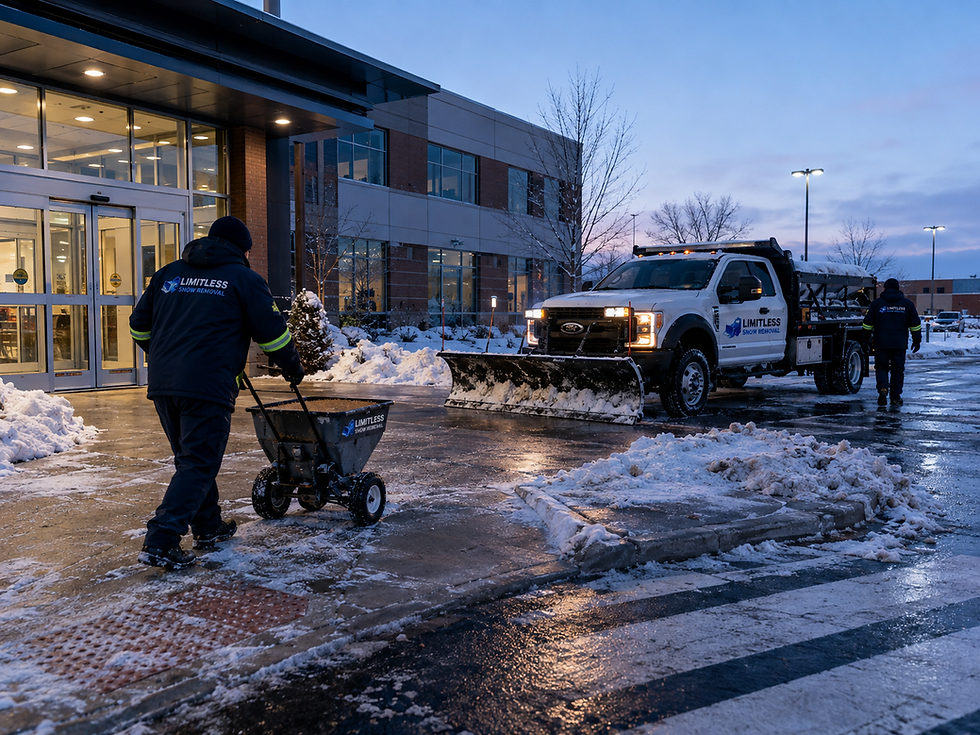
The Entrance Looks Fine. The Risk May Have Moved.
A freshly cleared entrance creates an immediate impression that winter service is under control. The doors are accessible, the concrete looks clean, and customers can walk directly inside.
But commercial properties rarely operate through one doorway.
Employees may use side entrances. Delivery drivers approach loading areas. Customers cross parking lanes. Contractors enter from service corridors. People move between buildings, garbage enclosures, transit stops, parkades, and pedestrian crossings.
For larger Burnaby properties, multi-entrance winter traffic coordination means looking beyond whichever doorway receives the most attention.
The problem is not necessarily poor snow removal. It is incomplete prioritization.
A main entrance can be cleared perfectly while an employee path remains packed with snow. A rear loading approach can collect slush while the customer walkway appears dry. An accessible curb ramp can develop refreeze several hours after the initial clearing.
A useful post-storm question is therefore not, “Are the entrances clear?”
It is, “Can people complete the journeys they actually make across the property?”
That shift changes winter maintenance from doorway service into whole-site risk management.
Coastal Conditions Create Uneven Winter Risk
Whole-property inspections become especially important when weather changes quickly and moisture remains after the visible snow disappears.
For Vancouver & North Shore sites, ocean-influenced winter property response requires attention to surfaces that may behave differently within the same property.
One area can be wet while another is beginning to freeze. A sheltered walkway may retain different conditions from an exposed parking area. Snow stored beside a slope may release meltwater toward a previously cleared route.
Shade and Runoff Create Repeat Trouble Spots
Every property develops patterns.
A walkway beside a tall building may remain shaded. Water may repeatedly cross the same curb ramp. Snowbanks can release runoff toward drains or parking lanes as temperatures rise.
These areas deserve more than a generic inspection.
Over time, property managers and winter contractors can identify repeat trouble spots and build them into service priorities. That creates a smarter response than assuming every surface carries the same risk.
Parking Areas Deserve a Walking Inspection Too
Parking lots are often evaluated from inside a vehicle or snow-removal machine.
That perspective can miss smaller pedestrian hazards.
The route from a parking stall to the building may cross compacted snow, drainage channels, curb transitions, islands, or sections where vehicles have carried slush back onto cleared pavement.
A property can therefore look operational from behind a windshield while still presenting uncomfortable conditions on foot.
Older Streetscapes Need a Different Walkway Check
Some commercial environments are naturally more complex than open suburban properties.
In New Westminster, heritage-district winter walkway care can involve tighter pedestrian spaces, older street patterns, grade changes, stairs, narrow approaches, and limited areas for snow storage.
Those constraints make the “clear the entrance and move on” approach particularly weak.
Crews should consider how people move between the building and the surrounding public-facing areas. Where does a cleared private walkway meet another surface? Are there changes in elevation? Does water collect near stairs or narrow passages? Is snow storage beginning to reduce usable walking space?
Another issue is repeated compression.
Even a small amount of residual snow can change quickly when hundreds of footsteps cross the same narrow route. Vehicle traffic can have a similar effect around entrances and loading areas.
The result is that high-use areas may need attention for different reasons than quiet sections of the property.
Whole-site winter maintenance should respond to actual use patterns, not simply square footage.
Whole-Site Service Requires Zone Priorities
Managing every surface with identical urgency is rarely practical.
The better approach is multi-zone snow and ice servicing based on how different areas affect property operations.
A commercial site might separate winter priorities into main pedestrian entrances, accessible routes, vehicle circulation, employee access, loading areas, parking sections, secondary walkways, stairs, ramps, and snow-storage zones.
Each zone can then have a clear service expectation.
This helps contractors deploy appropriate resources. Large equipment can handle broad vehicle areas while smaller machines or hand crews focus on confined spaces. Granular ice control can be directed toward surfaces where conditions justify treatment instead of being treated as a substitute for proper clearing.
Limitless Snow Removal supports this kind of operating model with modern equipment, fast clearing, safety-focused ice control, scheduled plans, and 24/7 service availability.
Transparent pricing is part of the same conversation. Property teams should understand which zones are included, how changing conditions are handled, and when additional service may be required.
A whole-site plan is stronger when responsibilities are clear before bad weather arrives.

The Back Door Test: Would Your Property Still Pass?
One of the simplest property-management exercises is to stop evaluating the site from the main entrance.
Start somewhere less obvious.
Walk the Route Employees Actually Use
Begin at an employee parking area and walk toward the staff entrance.
Then try the delivery route. Check the path from accessible parking. Walk from a secondary building to the main property. Inspect stairs, ramps, corners, crossings, and areas beside snowbanks.
The exercise often reveals why entrance-focused inspections can create false confidence.
Problems tend to exist between destinations.
A doorway may be perfectly clear, but reaching it can require crossing compacted snow or an untreated transition. A loading dock may be usable, yet the pedestrian path beside it is not. A parking aisle may be open while the nearest curb ramp remains obstructed.
Review the Property After Conditions Change
The inspection should not necessarily end with the first service visit.
Traffic moves slush. Snow piles melt. Temperatures change. Water travels across pavement. Previously cleared surfaces can become wet again.
Return inspections are particularly valuable around known trouble spots.
The objective is not to maintain a property in a permanently perfect condition regardless of weather. It is to recognize that winter risk moves and to have a practical method for finding it.
Clear Is Not the Same as Controlled
Commercial winter service is easiest to judge where the work is most visible.
That is why entrances receive so much attention.
But a property manager looking at the bigger operational picture should consider the entire journey: from the vehicle to the entrance, from the loading zone to the building, from one structure to another, and from the property perimeter to the places people actually need to reach.
Good winter management connects those routes.
It also considers snow storage, drainage, refreeze, pedestrian traffic, equipment access, changing temperatures, and the possibility that an area requiring little attention during the first service cycle may become important later.
Scheduled service helps establish that structure. Reliable clearing helps reopen critical areas quickly. Modern equipment allows crews to match the machine to the site. Twenty-four-hour availability adds flexibility as conditions evolve.
But the fundamental principle is simpler:
Do not confuse the condition of the front door with the condition of the property.
The best winter check is often the one that starts after you turn away from the entrance.
Walk the perimeter. Follow the employee route. Check the loading area. Look at the curb ramps. Inspect where water travels. Revisit the surfaces that repeatedly create problems.
Because a commercial property is not truly winter-ready when one entrance looks good.
It is winter-ready when the routes people actually depend on have been considered as one connected system.


Comments