

The Sidewalk Productivity Gap: Why Machines Beat Shovels on Large Commercial Properties


When Sidewalk Distance Becomes the Real Bottleneck
On a small property, a shovel may be exactly the right tool. On a large commercial site with hundreds or thousands of feet of pedestrian routes, however, the problem changes completely.
The challenge is no longer clearing one doorway. It is maintaining consistent access across entrances, curb connections, transit-facing sidewalks, loading areas, and long stretches of pavement while snow continues to fall.
That becomes especially apparent at dense properties in Vancouver and the North Shore, where constrained curbside snow removal sequencing may require crews to work through narrow sidewalks without blocking vehicle lanes, storefront access, or pedestrian movement.
A sidewalk machine can maintain a predictable working width and move through long routes without the repeated scoop-lift-throw cycle required by manual shoveling. That matters because productivity drops quickly when workers must cover significant distances while repeatedly moving the same snow.
Machines also make route planning easier. Instead of assigning several people to overlapping sections and hoping they finish together, a contractor can define a clear sequence and estimate how quickly each section should progress.
For a property manager, that translates into more predictable access during the storm.
Plan Where the Snow Goes Before Clearing Starts
Mechanical sidewalk clearing is only efficient when snow has somewhere appropriate to go.
At a large Burnaby business property, business park snow storage logistics can determine whether a machine saves time or simply pushes the problem from one place to another.
Long sidewalk runs may pass landscaped beds, parking stalls, driveway crossings, building entrances, hydrants, and drainage structures. If an operator reaches the end of a route without a suitable snow-placement strategy, accumulated snow can begin narrowing usable space.
Storage points should be mapped in advance
Contractors should identify acceptable discharge and storage areas before winter.
Snow should not be repeatedly moved onto pedestrian crossings, accessible routes, visibility zones, or locations where future meltwater will travel back across cleared pavement.
A machine allows crews to move snow quickly, but speed without planning can create large piles in exactly the wrong places.
Clearing width should remain consistent
Manual crews naturally vary in pace and technique. One person may clear a wide path while another leaves a narrower section around an obstacle.
Mechanical equipment provides a more repeatable clearing width over long stretches. On high-traffic commercial properties, that consistency can be just as valuable as raw speed.
The property ends up with a connected route rather than a series of individually cleared patches.
Match the Route to the Terrain
Not every sidewalk is flat.
Commercial sites around Coquitlam and the Tri-Cities may include sloped pedestrian paths, elevation transitions, stair approaches, ramps, and routes running alongside hillside parking areas.
That makes slope-dependent snow route sequencing important.
An operator should not simply begin at whichever end of the property is closest. The direction of travel can affect where snow is pushed, whether material accumulates downhill, and how easily equipment can maintain traction.
Machines used on these routes must also match the physical site. Width, turning radius, grade capability, pavement condition, curbs, railings, and pedestrian traffic all influence equipment selection.
This is one area where “machine versus shovel” is the wrong question.
The better question is which tool should handle each part of the route.
A suitable sidewalk machine can clear the long, open sections efficiently. Manual crews can then focus on stairs, narrow transitions, door thresholds, corners, and other detailed areas that machinery cannot reach cleanly.
That combination avoids wasting skilled labour on hundreds of metres of repetitive straight-line clearing.
Divide Large Properties Into Working Zones
The larger a property becomes, the less practical it is to treat sidewalks as one continuous task.
At expansive commercial sites in Surrey and White Rock, sprawling commercial lot snow zone planning helps coordinate pedestrian clearing with parking-lot plowing, vehicle traffic, tenant access, and snow storage.
A useful zone plan might separate main entrances, perimeter sidewalks, parking-to-building routes, accessible connections, loading areas, and secondary pedestrian paths.
Each zone can then have its own service priority.
This matters during active snowfall because crews rarely have unlimited time between clearing cycles. A property manager needs the most important routes restored first rather than waiting for one team to complete the entire perimeter.
Mechanical sidewalk equipment helps make that prioritization realistic.
An operator can clear the primary route quickly and move to the next critical zone while manual workers complete detail work behind them. When accumulation continues, the machine can repeat the cycle without requiring an entirely new labour deployment.
That is a much more scalable model for a large property.
Machines Win the Distance; Shovels Win the Details
Sidewalk machines are not replacements for every shovel.
They are replacements for using shovels where mechanical equipment is clearly more productive.
Use machines for repetitive coverage
Long sidewalks, wide pedestrian corridors, large plazas, interconnected buildings, and repeated straight runs are natural candidates for mechanization.
The Snow & Ice Management Association notes that stand-on machines can clear snow quickly and are highly maneuverable, while UTVs with plows can cover large commercial areas efficiently. SIMA also emphasizes selecting equipment according to the site's size and operating characteristics rather than applying one tool everywhere.
That distinction is important.
Productivity comes from matching equipment to the surface—not from simply buying a machine.
Keep shovels where precision matters
Hand tools remain valuable around doors, stairs, railings, curbs, narrow ramps, hydrants, and obstacles.
SIMA similarly identifies shovels as especially useful for detailed work around entrances, pavement transitions, stairs, railings, ramps, docks, and other constrained areas.
The strongest commercial operation therefore uses both.
Machines handle production. People handle precision.
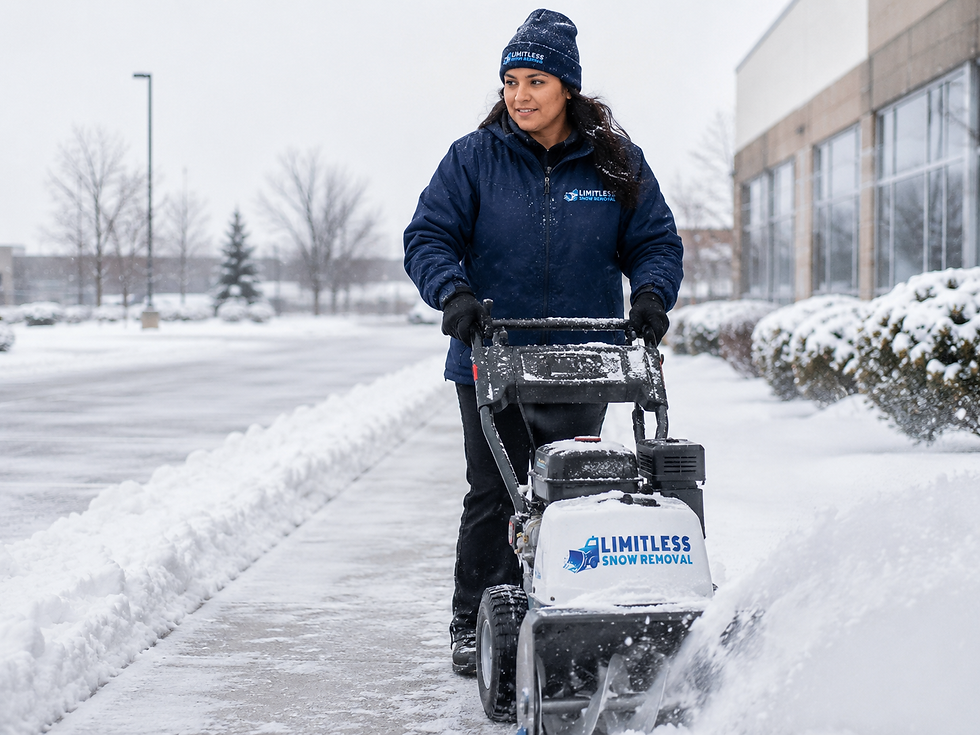
Consistency Is the Advantage Property Managers Actually Feel
Speed gets most of the attention when contractors discuss sidewalk machines, but consistency may be the bigger commercial benefit.
Large manual crews can experience fatigue, uneven pacing, staffing shortages, and differences in technique. During a long storm, those variations can become visible across the property.
Mechanized clearing creates a more repeatable production process.
Limitless Snow Removal uses modern equipment as part of a broader winter-service approach that includes fast, reliable clearing, 24/7 availability, safety-focused ice control, transparent pricing, and scheduled plans.
For large properties, the value is not simply that a machine travels faster than someone with a shovel.
It is that routes can be planned, production can be repeated, crews can be allocated more deliberately, and labour can be concentrated where human attention actually provides the most value.
That becomes increasingly important when snow continues falling for hours.
A manually cleared sidewalk may begin accumulating again before a crew reaches the far end of a large site. Faster mechanical cycles allow priority routes to be revisited sooner, reducing the gap between one clearing pass and the next.
The result is a more consistent pedestrian environment across the property.
Shovels will always have a place in commercial snow removal. They are simple, precise, and indispensable around detailed areas.
But on a property with extensive sidewalk networks, relying on them as the primary production tool can turn distance into labour, labour into delay, and delay into inconsistent access.
The better approach is straightforward: use machines where coverage matters, use people where precision matters, and design the route so both work together.
That is how a large commercial property gets cleared as one coordinated site rather than one shovel-width at a time.


Comments