

The Fleet-Size Illusion: Why the Contractor With the Most Trucks May Still Be the Wrong Choice

Capacity Is What Reaches Your Property
A long row of plow trucks makes an impressive photograph. For a commercial property manager, however, the more useful question is not how many trucks a contractor owns. It is how much dependable capacity will actually be available to your property during a widespread storm.
There is a significant difference.
A contractor might own twenty trucks but have nineteen of them committed elsewhere before your site is serviced. Another may operate a smaller fleet with tightly planned routes, appropriate equipment, backup capacity, and clearly defined property priorities.
That is why storm-driven commercial access management should be evaluated as an operating system rather than an equipment count.
Ask how properties are assigned before storms. Find out whether equipment is dedicated to specific operating zones, what happens when a machine breaks down, and whether the contractor keeps reserve capacity for changing conditions.
The best contractor is not necessarily the company that can show you the largest fleet.
It is the company that can explain exactly how its resources will reach your entrances, parking areas, loading routes, and pedestrian surfaces when everyone else needs snow service at the same time.
Coastal Conditions Change the Capacity Equation
Commercial properties do not always experience the same storm in the same way.
For sites across Vancouver and the North Shore, elevation, exposure, wet snow, rainfall, temperature changes, and coastal moisture can create different operational requirements within a relatively compact region.
That makes salt-air pavement freeze risk management part of the capacity conversation.
A contractor focused solely on plowing may have enough trucks for snowfall but insufficient operational flexibility when the greater problem becomes slush, wet pavement, drainage, or overnight refreeze.
Ask what happens after the plowing cycle
A property can appear clear at 2:00 p.m. and become problematic several hours later.
Snow piles begin melting. Vehicles distribute slush. Shaded areas cool faster than exposed pavement. Water crosses pedestrian routes and ramps.
The contractor therefore needs capacity for follow-up work, not just the initial push.
Specialized equipment can matter more than another truck
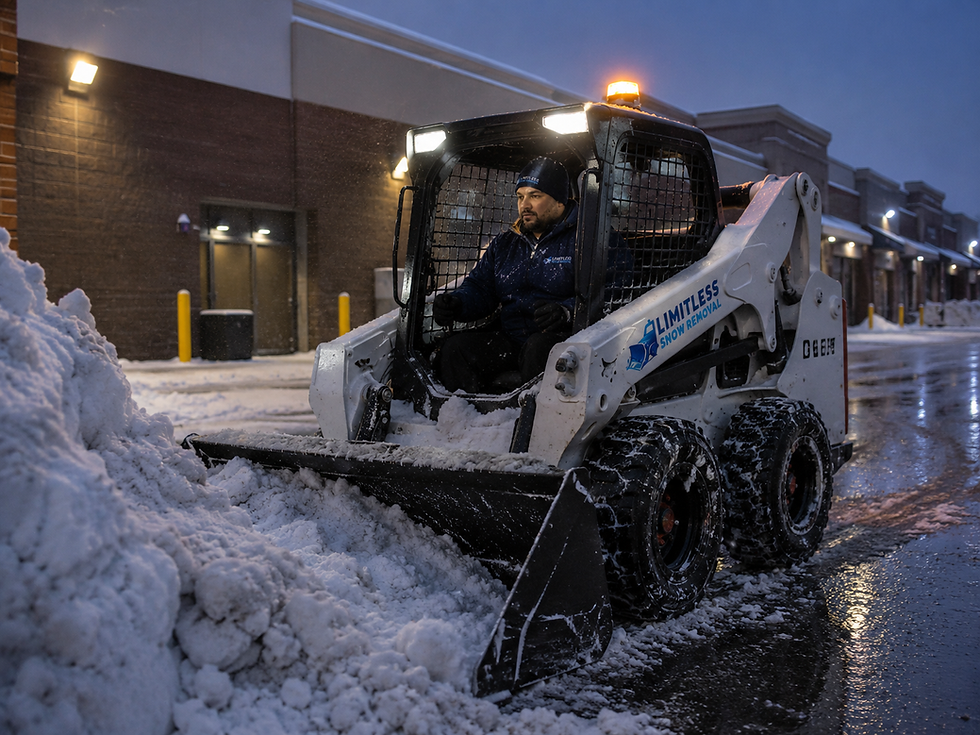
A pickup plow may work extremely well on an open parking lot. It is less useful on long sidewalks, narrow building approaches, tight courtyards, or areas with low clearance.
Modern winter operations require a mix of capabilities.
A vendor with fewer vehicles but better equipment matching may be able to complete the property more effectively than a larger contractor trying to make standard trucks handle every surface.
A Big Plaza Can Expose a Small Operations Plan
Commercial plazas are excellent tests of actual contractor capacity.
A property may have a large parking field, multiple tenant entrances, loading areas, drive-through traffic, sidewalks, accessible spaces, delivery routes, and several places where snow can—or cannot—be stored.
For properties serving Surrey and White Rock, effective regional shopping plaza snow circulation requires all of those components to remain connected during active winter service.
Plowing one large central lane is not enough if snowbanks restrict visibility at an exit or customers cannot move safely from their cars to storefronts.
Capacity must therefore be measured surface by surface.
How many machines are needed to handle the parking area before peak customer traffic? Who completes pedestrian routes? Is compact equipment available for tighter sections? Can snow be relocated when storage areas begin filling?
This is where a fleet number becomes misleading.
Ten trucks assigned poorly can interfere with each other. Three pieces of correctly selected equipment following a planned sequence may accomplish far more useful work.
Commercial property managers should evaluate production logic, not equipment inventory.
Route Timing Can Make or Break the Morning
Dense employment areas create another challenge: many properties become busy at almost the same time.
In Burnaby, urban employment hub snow response planning may require contractors to complete several high-priority sites before early employees, deliveries, customers, and building services begin arriving.
A contractor that accepts too many properties within the same service window can have a large fleet and still fall behind.
Travel time matters too.
A truck crossing a large service territory is not clearing snow. During heavier conditions, normal travel assumptions can deteriorate quickly. A route that works perfectly during a dry preseason test may perform very differently when roads are congested and snow is accumulating.
This is why route density deserves attention during contractor evaluation.
Ask how many sites a crew is responsible for, approximately where those sites are relative to one another, and what happens if an earlier property requires significantly more time than expected.
Good contractors build time into their operating plans for reality.
Poor ones build routes that work only when everything goes perfectly.

Put the Sales Pitch Through a Storm Test
Contractor evaluation becomes easier when property managers replace broad questions with operational ones.
Instead of asking, “How many trucks do you have?” ask what equipment is planned for your property.
Ask about the actual site plan
A credible contractor should be able to discuss:
priority vehicle and pedestrian routes;
equipment appropriate for each surface;
anticipated snow-storage locations;
drainage and refreeze areas;
service sequencing;
response outside normal business hours;
contingencies for equipment problems.
This approach is consistent with current snow-industry guidance. SIMA's 2025 standard for procuring and planning snow and ice management services recommends site-specific assessments and explicitly calls for identifying required or prohibited equipment, dedicated equipment needs, and approved staging areas.
That is a much higher standard than asking whether the contractor owns enough plow trucks.
Ask what happens when the plan goes wrong
A vendor should also be able to explain the backup plan.
What happens when equipment fails halfway through an event? What if snowfall lasts considerably longer than predicted? Can another crew be reassigned without abandoning another client?
Industry fleet guidance makes the same point: contractors need to understand equipment utilization and crew assignments so additional work does not spread resources too thin.
Capacity without reserve capacity is fragile.
Choose Execution Over Equipment Count
The strongest snow contractor should be judged by what happens at the property during difficult conditions.
Did crews arrive when expected?
Was the right equipment used?
Were parking areas, entrances, loading routes, and sidewalks coordinated instead of treated as separate jobs?
Could the contractor respond when conditions changed after the first service cycle?
Those questions reveal operational capability far more accurately than the number of trucks printed in a proposal.
Limitless Snow Removal approaches commercial winter operations around execution rather than fleet theatre. Modern equipment is important, but it is paired with fast, reliable clearing, 24/7 service availability, safety-focused ice control, transparent pricing, and convenient scheduled plans.
That combination allows property preparation to begin before the storm rather than after access has already deteriorated.
For property managers comparing vendors, this leads to a useful rule: never evaluate capacity in isolation.
A contractor must have enough equipment, but that equipment also needs the right operators, sensible route density, appropriate assignments, service priorities, backup options, and enough remaining flexibility to manage changing conditions.
The snow industry itself increasingly emphasizes this distinction. The National Association of Landscape Professionals notes that fleet effectiveness comes from matching equipment to the specific site and planning machine and crew assignments early enough to avoid overextending resources.
A huge fleet can certainly be an advantage.
But only when the machines are suitable, available, positioned correctly, and supported by an operating plan that survives the storm.
Otherwise, the property manager is not buying capacity.
They are buying a truck count.


Comments