

One City, Several Storms: Why One Burnaby Snow Crew Cannot Cover It All


The Sidewalk Can Freeze Before the Parking Lot Does
A commercial property can look straightforward on a route map and behave completely differently once a winter event begins. One parking lot may receive wet snow that melts almost immediately, while a shaded pedestrian approach a few blocks away develops compacted slush and ice.
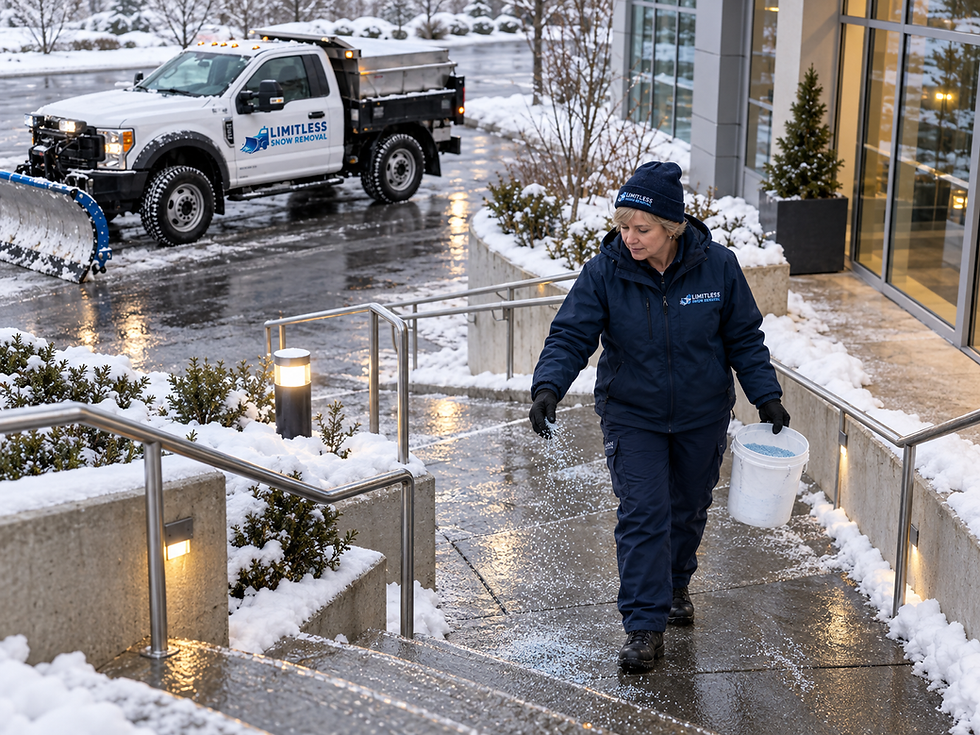
That difference makes retail plaza pedestrian route freeze control a separate operational priority rather than a small extension of parking-lot plowing. Storefront walks, curb ramps, crossings, stairs, and entrances are affected by foot traffic, building shade, drainage, and snow pushed from adjacent surfaces.
A crew clearing a large parking field cannot simply finish the vehicle lanes and assume the rest of the site will remain usable. Pedestrian areas frequently require smaller equipment, granular ice control, manual detail work, and later inspections.
The City itself uses a priority-based approach to winter operations. Its snow-removal routes consider traffic volume, road classification, terrain, and accessibility, with certain steep roads receiving specific priority. That illustrates an important commercial principle: winter service has to be organized around conditions and function, not around the idea that every surface can be treated equally.
For a contractor, this means allocating different crews or equipment to different surface types instead of trying to make one truck solve every problem.
Coverage Must Follow Elevation and Travel Time
Geography changes the value of every minute during an active storm.
Properties closer to Vancouver & North Shore can experience dramatically different conditions as routes climb from lower commercial areas toward elevated sites. That is why mountainside commercial access snow sequencing depends on deployment order as much as equipment capability.
Imagine one crew responsible for several properties separated by elevation changes. At the first site, the crew may encounter wet pavement and light accumulation. Twenty minutes later, the next property may already have compacted snow on a steep driveway.
Travel time between those properties is not productive clearing time.
The longer equipment spends moving between distant or differently affected zones, the less capacity remains for repeat visits, ice treatment, loading-area work, and pedestrian routes.
Commercial route design should therefore group properties intelligently. Contractors need to consider elevation, road access, expected accumulation, service triggers, and how difficult it will be to reposition equipment during worsening conditions.
This is also why having “enough equipment” is not the same as having equipment in the right place.
A well-positioned smaller unit can sometimes deliver more useful capacity than a large truck that must cross the city before reaching the next priority property.
A Loading Dock Can Be a Different Winter
Industrial properties add another layer of complexity because they cannot always pause operations while snow crews work.
At a property near New Westminster, riverfront loading area winter traction control may require attention to truck approaches, dock aprons, employee walking routes, drainage points, and areas where trailers restrict equipment movement.
The loading area may also behave differently from the front parking lot.
Large vehicles repeatedly compress snow. Trailer shadows reduce solar exposure. Snowbanks can release runoff toward dock approaches. Trucks track slush across areas that were previously cleared.
A single crew moving from the customer entrance to the loading area may discover that conditions have already changed by the time it arrives.
This is why commercial snow operations benefit from zone-based planning.
An industrial site may need the main vehicle lane opened first, followed by dock approaches, employee access, targeted ice control, and another check after the busiest delivery period.
The service sequence should reflect how the property actually operates rather than follow one standard loop simply because it is convenient for the contractor.
Meltwater Requires a Separate Response Plan
Snow accumulation is only the first stage of many winter events.
On sloped properties serving Coquitlam & Tri-Cities, sloped commercial entrance meltwater management becomes especially important when temperatures move above and below freezing.
An upper snow pile may begin melting during the afternoon. Water follows the grade toward an entrance, ramp, or pedestrian crossing. The original snow has already been cleared, but the property is quietly producing the conditions for another ice problem.
A crew that has moved far away may not return until someone reports the hazard.
A stronger operating plan identifies these locations before the season begins.
Drainage paths, shaded sections, snow-storage areas, steep approaches, and known refreeze points can be marked in site notes so dispatch understands where follow-up attention is likely to be required.
That changes the contractor's job from simply reacting to accumulation into managing the full weather cycle.
It also reinforces why city-wide coverage cannot depend on one mobile crew. The property that needs a plow at 6 a.m. may need ice control rather than another plow at 2 p.m.
Those are different tasks, often occurring simultaneously across different locations.
One Crew Becomes a Bottleneck Fast
The problem with a single-crew model becomes most visible when several service demands happen at once.
Storms create parallel work, not sequential work
Commercial properties do not politely develop problems one after another.
One property needs its parking lot opened. Another requires sidewalk clearing. A third develops refreeze on a ramp. A fourth has delivery trucks arriving while accumulation continues.
If one crew must complete every task sequentially, every additional stop pushes another property further down the route.
That is not simply a speed problem. It is a capacity-design problem.
Effective contractors divide work by geography, equipment type, surface priority, and changing conditions. A plow unit can concentrate on vehicle areas while other resources address pedestrian routes or ice control.
Repeat visits consume real capacity
The first pass is rarely the entire winter operation.
Weather continues. Vehicles redistribute snow. Meltwater moves. Temperatures fall. Wind can refill exposed sections.
A realistic route therefore needs capacity for both initial clearing and follow-up work.
Scheduling every available crew at maximum capacity during the first pass can leave no practical room for conditions that develop later.
What Property Managers Should Expect from a Snow Contractor
Commercial buyers should evaluate snow contractors by asking how their capacity is organized, not simply how many trucks they own.
Ask how the route is built
A contractor should understand site geography before the storm.
Property managers can ask how sites are grouped, what happens when conditions vary between service zones, which equipment is assigned to constrained areas, and how urgent changes are handled without abandoning previously scheduled properties.
Limitless Snow Removal combines modern equipment with fast, reliable snow clearing and 24/7 service so winter operations can be organized around changing site conditions rather than a single linear route.
Convenient scheduled plans also allow access priorities, service areas, and operational expectations to be established before crews are under storm pressure.
Look beyond the first plow pass
A strong winter plan should account for parking lots, entrances, sidewalks, loading areas, ice control, and changing surface conditions.
Safety-focused ice management matters because removing accumulated snow does not eliminate every freeze hazard. Transparent pricing also helps property managers understand whether their agreement covers only mechanical clearing or includes the broader service cycles their property may require.
The underlying lesson is simple.
A city with hills, commercial districts, industrial corridors, dense development, and different microclimates cannot realistically be treated as one continuous snow route.
The contractor that performs best is not necessarily the one promising that a single crew can cover everything.
It is the one that understands where crews need to be before several properties need them at the same time.


Comments